Brain networks
How brain regions coordinate their activity in autistic people, how the idea of weak long-range and strong local wiring has fared in large studies, what is known about three large networks, and what the oxytocin receptor findings amount to.
How parts of the brain work together in autistic people. An old idea about long and short links has not held up well. Some other findings are still small and unsure.
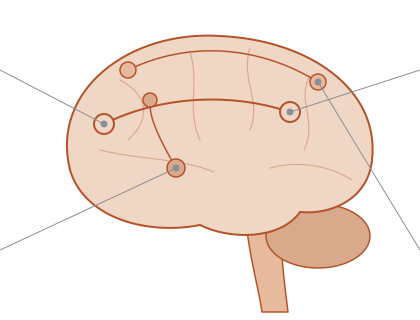
The under-connectivity theory Hypothesis
Functional connectivity is how closely activity in separate brain regions rises and falls together over time.1 In 2004, a brain-scan study that measured activity during sentence reading (a task-based design, before later methods for handling head movement) found that language areas were less in step with each other in autistic participants without an intellectual disability than in a comparison group matched for verbal IQ. The authors proposed "a lower degree of information integration and synchronization" across large networks, and called this under-connectivity.1
The same year, a review proposed that in the autistic brain, strong local connections may develop alongside weak long-range ones, and offered this as a framework that could tie together findings from genetics and brain tissue.2
Parts of the brain often get busy and quiet at the same time. Scientists call this working in step. They measure it with brain scans.1
In 2004, one study scanned people while they read sentences. It looked at autistic people who did not have an intellectual disability. Their language areas were less in step than in other people.1 The scientists thought autistic brains might share information less across long distances. They called this under-connectivity.1
That same year, a review put forward a bigger idea. Maybe autistic brains have strong short links and weak long links.2 It was offered as a way to tie many findings together.2
This section describes a proposal. The next sections show how it has fared; in its simple form it has not held up.
Functional MRI: a scan that tracks changes in blood oxygen as a stand-in for brain activity, many times a minute.
How closely the activity of two brain regions rises and falls together. It does not show a physical cable between them.
This is an idea, not a finding. Tests later backed part of the long-link idea, but not the short-link part.
How closely two brain areas get busy and quiet together. It is not a real wire between them.
What large samples found Emerging
The Autism Brain Imaging Data Exchange (ABIDE) pooled 1,112 resting-state scans from many sites: 539 autistic people and 573 non-autistic people aged 7 to 64. Its first analysis, of 360 autistic and 403 non-autistic males, found both weaker and stronger connections. Weaker ones were more common, especially between areas of the cortex and between the two halves of the brain.3
Later studies that combined several large samples also found both directions, but not in the same places. A 2019 study of four cohorts found weaker connections mainly in regions for sensing and movement, and more strongly connected hubs in the front and top of the brain. The pattern did not depend on age, sex or medication, though with few females a sex difference would be hard to detect, and autistic and non-autistic people overlapped a great deal.4 Studies that included more autistic females, also drawn from ABIDE, report differences by sex. In one, of 42 autistic males and 42 autistic females aged 7 to 30, autistic males showed weaker connectivity than non-autistic males and autistic females stronger connectivity than non-autistic females.46 In another, of 362 autistic males and 82 autistic females aged 7 to 18, connectivity between the two halves of the brain in one region at the back was lower in autistic females, and this sex difference was repeated in one of two independent samples.47 A 2023 analysis of 1,824 people aged 5 to 58, 796 of them autistic, found weaker links within sensory and attention networks, and stronger links between the default mode network and the rest of the brain and between the cortex and deeper structures.5
Results also depend on how the data are analyzed. In one multi-site study, no single type of connectivity measure gave results that held across sites, and results were consistent only in large samples.6 A careful study of autistic adults without an intellectual disability found largely typical connectivity, with a few differences in frontal and temporal cortex, nearly all weaker.7 Most of these samples were mostly male and left out autistic people with an intellectual disability or who could not lie still in the scanner, so the findings may not apply to all autistic people.3,7,18 One review suggests that studies disagree partly because of participants' age and sex, scan design and analysis method, and because autistic people differ so much from one another.8
A separate line of evidence uses diffusion imaging to measure the white-matter tracts themselves. White matter is made of the bundles of fibers that link brain regions, and there water spreads more easily along the fibers than across them; fractional anisotropy (FA) measures how directional that spread is. A 2026 meta-analysis pooled 66 diffusion-imaging studies (2,231 autistic and 1,856 non-autistic people; study mean ages 2 to 50 years) across 12 tracts and found lower FA in nine of them, a moderate effect (Hedges' g = -0.30 to -0.50), and higher mean diffusivity, a larger difference (Hedges' g = 0.29 to 0.97), in eight. Both measures are taken to reflect properties such as fiber coherence, myelination and axonal density.51 The samples were mostly male and few reached later adulthood, and the authors note that group differences in head movement can inflate the effects. As with the connectivity findings, this is a group average, and autistic and non-autistic people overlap heavily.
Scientists from many places shared their brain scans. One big set is called ABIDE. It has over 1,000 people aged 7 to 64.3 The first look used only boys and men. It found some links weaker and some stronger. Weaker links were more common.3
Later big studies also found both weaker and stronger links. But they did not find them in the same places.4,5 Autistic and non-autistic people overlapped a lot.4
The way scientists study the scans matters too. In one study, no method gave the same answer at every scanning site.6 Another careful study of autistic adults found their links mostly typical.7 One review says age, sex and study methods help explain why studies disagree.8 Autistic people also differ a lot from each other.8 Most studies included mostly boys and men. They left out people who could not lie still.3,7,18 Studies with more girls and women found that some differences depend on sex.46,47
A different kind of scan looks at the brain's wiring. Bundles of nerve fibers carry signals between brain areas. They are called white matter. A 2026 summary of 66 studies looked at this wiring. On average, it was a little less organized in autistic people. This was true in 9 of the 12 bundles studied.51 Most people in the studies were boys and young men. The difference was small. Many autistic and non-autistic people were the same.
The large connectivity studies agree that both weaker and stronger connections occur, but they draw largely on the same shared data (ABIDE) and overlapping European cohorts, so they are not independent, and they disagree on which connections differ. A meta-analysis of the white-matter tracts themselves finds a more consistent direction (lower fractional anisotropy across most tracts), in samples that are young and mostly male.
A scan taken while the person lies still and does nothing in particular, used to measure connectivity without a task.
Big studies agree on some things. But many of them use the same shared set of scans, so they are not separate checks. A summary of wiring studies found the wiring a little less organized in autistic people. But it measures the wiring itself, not how brain areas work together.
Local over-connectivity Emerging
The other half of the theory, stronger local connections, has less support. A systematic review of EEG and MEG studies, which record the brain's electrical activity, found relatively strong support for weaker long-range connectivity, but could not say whether local connectivity differs. The studies varied too much to be pooled in a meta-analysis.9
One fMRI study of adolescents found stronger local connectivity in regions at the back of the brain, and more of it went with more marked autistic traits. A subgroup with fewer traits showed weaker frontal connectivity instead.10 A 2024 meta-analysis of fMRI studies that measured local connectivity as regional homogeneity, in people aged 18 or under, found weaker local connectivity in parts of the default mode and sensorimotor networks, and no regions with stronger local connectivity. Its authors say the result needs confirming.11 A study of 53 autistic people from one ABIDE site, split into children, adolescents and adults, found the pattern depended on region: weaker local connectivity in sensory regions and stronger local connectivity in regions for complex processing, at every age. In autistic children and adolescents, stronger local connectivity went with more marked autistic traits.44
The idea also said short, local links would be stronger. There is less support for this part. A review of studies that record the brain's electric signals could not tell.9
One study of teenagers found stronger local links at the back of the brain.10 A later review of many studies in young people found no areas with stronger local links. It found some areas with weaker ones.11 Its authors say this still needs checking.11 Another study found it depends on the brain area. Local links were weaker in areas for the senses. They were stronger in areas for harder thinking.44
The direct tests disagree. A review and a meta-analysis find no general local over-connectivity; single studies find stronger local connectivity in some regions and weaker in others.
Recordings of the brain's electrical (EEG) or magnetic (MEG) activity from the scalp, fast enough to follow activity millisecond by millisecond.
The tests of this disagree. Scientists are not sure yet.
Changes with age Emerging
In 2013, one group proposed that the conflicting findings could be reconciled by age: young autistic children would show stronger connectivity and adolescents and adults weaker connectivity.12 The same group found stronger connectivity in autistic children, across short- and long-range connections, in three samples it analyzed itself, and in these children stronger connectivity went with more marked social differences.13 A study from the same group that split ABIDE participants by age (26 children, 28 adolescents and 18 adults with autism) found stronger connectivity within networks only in children aged 11 and under, weaker links between networks in children and adolescents, and no differences in adults.14
The 2023 analysis of 1,824 people found no statistically significant change in the connectivity differences with age, or between the sexes; a study of this design, scanning each person once, has limited power to detect either.5 A 2024 study of 1,218 people aged 5 to 40 in ABIDE compared each person with what is typical for their age and found that connectivity far from the typical range, mainly in the default mode network, became more common with age in autistic people and less common in non-autistic people.15
The age-split study and the 2024 study compared different people at different ages, each scanned once.14,15 One small study did follow 16 autistic and 22 non-autistic young people, almost all boys without an intellectual disability, scanning each twice about three years apart. As non-autistic youth grew older, the default mode and central executive networks became more opposed in their activity; in autistic youth they did not, so the groups differed only in late adolescence. The authors call the findings preliminary.45
One team had an idea about age. Maybe young autistic kids have stronger links. Maybe teens and adults have weaker links.12 That team found stronger links in autistic kids in three groups.13 Another of their studies found stronger links only in kids 11 and under.14
A much bigger study did not find that the differences changed with age.5 A different study found that unusual links became more common with age in autistic people.15
These studies looked at different people at different ages. They did not follow the same people as they grew up.14,15 One small study did follow young people for about three years. It found two networks grew apart in non-autistic teens but not in autistic teens. The scientists say this is an early result.45
The age pattern comes mostly from one research group, and a larger analysis did not find it. Several of these studies draw on the same ABIDE data.
A combined analysis of 1,824 people aged 5 to 58 did not detect a statistically significant change in the connectivity differences with age.5
Most of this comes from one team of scientists. A bigger study did not find the same thing.
A combined analysis of 1,824 people aged 5 to 58 did not detect a statistically significant change in the connectivity differences with age.5
Head movement in the scanner Established
Small head movements during a scan distort connectivity measures. In two independent studies of non-autistic people, movement lowered many long-distance correlations and raised many short-distance ones, even after standard corrections.16,17 That is the same shape as the under-connectivity theory. In one study of autistic adults, even small amounts of movement had large effects on connectivity measures.7
Removing people who moved too much creates a different problem. In one study of 545 children aged 8 to 13 without an intellectual disability, all scanned at one US center, autistic children were excluded more often: 28.5% against 16.1% under a lenient rule, and 81.0% against 60.1% under a strict one. The autistic children left were older, had milder social differences, better motor control and higher IQ than the group who were scanned.18 Results from such samples may not apply to autistic people who find it harder to stay still.
Correction methods differ in how well they work. A comparison of 14 methods in 393 young people found that removing the moving time points (censoring) reduced both the motion effect and its link to distance, at the cost of discarding data, while some other methods left a distance-dependent distortion.48
Moving your head a tiny bit during a scan changes the results. It makes long links look weaker. It makes short links look stronger.16,17 That is the same pattern as the old idea. So movement can look like a real brain difference.7
Scans with too much movement are often thrown out. In one study of 545 kids, autistic kids lost their scans more often.18 The autistic kids who were left were older. Their autistic traits were milder. So the results may not fit autistic kids who find it hard to keep still.18 Some ways of fixing movement work better than others.48
Two independent methods studies, in large non-autistic samples, show the distortion. Its effect on who ends up in autism studies comes from one large study.
Three large networks Emerging
The triple network model, proposed in 2011, holds that "deficits in access, engagement and disengagement" of three large networks appear across several conditions, including autism.19 The default mode network quietens during demanding outward tasks, which engage the central executive network. One group's fMRI studies suggest that a salience network, centered on the right anterior insula and the anterior cingulate cortex, switches between the two; this role was inferred statistically from the timing of activity.20,19
A review describes altered organization and development of the default mode network in autism.21 A meta-analysis of 10 studies found weaker connectivity between two of its hubs, the posterior cingulate cortex and the ventromedial prefrontal cortex.22 A 2025 meta-analysis of 26 studies found differences in connections of the medial prefrontal cortex, also part of this network.23 In a study of 22 autistic children aged 8 to 13 taking no medication, a weaker link between these two hubs went with more marked autistic traits, and the network was less separated from other networks.24 Studies drawing largely on the shared ABIDE data report the default mode network more connected to other networks, so they are not independent confirmations. One found this at ages 7 to 18 but not 18 to 25; the larger 2023 analysis found no change with age.5,25,26
Findings for the salience network point in both directions. In 20 autistic children aged 7 to 12, several networks including the salience network were more strongly connected, and salience network connectivity distinguished autistic from non-autistic children with 78% accuracy, and 83% in a second sample.27 In 24 autistic adolescents with an average age of about 16, it was less connected, and weaker connectivity went with lower scores on social-cognition tasks.28 An ABIDE study of 144 autistic people found more connectivity between the salience and default mode networks, and stronger coupling between the right insula and medial prefrontal cortex went with more social-responsiveness difficulties.26 In 169 young people aged 8 to 17, autistic girls showed more connectivity between the default mode and central executive networks than autistic boys.29
A network is a group of brain areas that work together. One idea looks at three big networks.19 The daydream network gets quieter when you focus on a task. A task network gets busy instead.20,19 Some scientists think a noticing network switches between the two.20 Its main part is called the insula.20
Reviews of many studies find weaker links inside the daydream network in autistic people, on average.21,22,23 In one small study, weaker links went with stronger autistic traits.24 Some studies find the daydream network more linked to other networks.5,25,26
Studies of the noticing network disagree. In one study of younger kids, its links were stronger.27 In one study of teens, they were weaker.28 Another study found it more linked to the daydream network.26 One study found that autistic girls and boys differed in these networks.29
The triple network model is a framework. Findings in autism come from small studies or from overlapping uses of the ABIDE data, and their directions differ by age and sample.
Regions along the brain's midline, including the medial prefrontal and posterior cingulate cortex, most active when attention turns inward.
Regions including the anterior insula and anterior cingulate cortex that respond to whatever stands out, inside the body or outside.
The three-network idea is a way of thinking. The autism findings come from small studies or reused scans, and they disagree.
The daydream network. It is busiest when your mind turns inward.
The noticing network. It reacts to things that stand out.
Oxytocin receptor gene methylation Emerging
Methylation is a chemical mark on DNA that can turn a gene's activity down. The oxytocin receptor gene (OXTR) makes the receptor that the hormone oxytocin acts on. A 2009 study found more methylation at some sites of this gene in blood from one group of autistic people, and in temporal cortex from a separate group of 8 autistic and 8 matched non-autistic people after death, mostly male. One site, -934, was higher in both blood and brain. In a subset of 4 brain pairs, the male autistic brains had about 20% less of the gene's mRNA.30
In 35 autistic men with IQs above 70, one site in the gene had more methylation in saliva than in 64 non-autistic adults of both sexes; because the groups differed in sex make-up, a sex effect cannot be ruled out. In 30 of the men, more methylation went with weaker resting connectivity between brain components involved in thinking about others' minds. Methylation at a second site, which did not differ between the groups, went with stronger connectivity between a reward area deep in the brain and the front of the brain.31 The authors call for replication in larger and more varied samples.31
Other studies disagree. One found less methylation in 27 autistic children, one found differences that depended on sex, one found no overall pattern in 80 children, and one that read the whole gene in 20 autistic adults found no site that differed.32,33,34,35 A 2018 systematic review judged the evidence on this gene's methylation and social behavior too thin to draw conclusions.36
Two findings often cited alongside these are about something else. Weaker reward-circuit connectivity in 41 autistic young people was linked to common variants in the gene's DNA sequence, not to methylation.37 A link between methylation and more effort from the front of the brain during social attention came from 54 non-autistic young adults.38
Oxytocin is a hormone that can affect social feelings. It works by fitting into receivers called receptors. A gene called OXTR builds these receptors. Cells can put small chemical tags on a gene. This is called methylation. It can make a gene less active.
One small study found more tags on this gene in some autistic people.30 It looked at blood, and at brain tissue from 8 autistic people after death.30 Another small study looked at 35 autistic men. One part of the gene had more tags.31 More tags went with weaker links between brain areas used to think about others.31 The scientists said bigger studies are needed.31
Other studies found fewer tags, or no difference at all.32,33,34,35 A review said there is not enough evidence yet to decide.36
Two other findings are often mixed up with these. One was about small spelling changes in the gene, not tags.37 The other studied only non-autistic adults.38
Each study is small, uses different tissue and different sites on the gene, and the results point in different directions.
A 24-week trial in 290 autistic children and adolescents aged 3 to 17 found that an oxytocin nasal spray did no better than a placebo on social withdrawal.39 Smaller studies are mixed: a 4-week trial in 32 children reported better social scores when baseline hormone levels were taken into account, most in children with the lowest oxytocin beforehand.49 A 2021 meta-analysis of 28 studies, including uncontrolled ones, reported benefits on social functioning but no strong evidence of benefit on other traits.50 Two 2026 meta-analyses, restricted to randomized trials, have not confirmed that benefit. One pooled 12 trials in 733 autistic children and adults and found no significant effect on social functioning (standardized mean difference -0.05);52 a broader one of 42 trials across mental disorders, autism among them, found only a small, non-significant overall effect.53
Each study is small. The studies point different ways.
A big trial gave autistic kids oxytocin nose spray for 24 weeks. It did not help more than a fake spray.39 Smaller studies have mixed results.49,50 Two newer summaries looked only at the fairest kind of test. It is called a randomized trial. In these, people are put into groups by chance. Both found no clear help.52,53
The computer-network picture Hypothesis
A popular way to picture the theory is a computer network: busy local nodes that process detail well, joined by a slow main line. The 2004 papers did tie weak long-range connections to weaker integration of information. The review also proposed that excess local connectivity produces strong but poorly selective local activity.1,2 A review of EEG and MEG studies proposed something similar, less wide-ranging integrating activity offset by more focused local activity, while noting that its own evidence on local connectivity was unclear.9
Several experiences the picture is used to explain are documented. On a self-report questionnaire, about half of autistic people score in the range for alexithymia, difficulty identifying and describing one's own feelings, compared with about 5% of non-autistic people.40 In one study, insula responses to another person's pain tracked alexithymia rather than autism.41 On a card-sorting task that requires switching rules, autistic people complete fewer sets and make more errors, with small to moderate differences across 31 studies.42 Monotropism, a theory developed with autistic authors, holds that autistic people allocate attention differently, with attention tied to a narrow range of interests.43
No study found as of October 2026 has tested whether alexithymia, task switching or deep focus in autistic people track long-range connectivity. In fMRI, the weak-long, strong-short pattern is also what head movement produces, though EEG and MEG studies, which are affected differently, also lean toward weaker long-range connectivity.16,9
People sometimes picture the brain as a computer network. Local parts handle detail well. A slow main line joins them. This is only a comparison. The 2004 papers did link weak long links to less sharing of information.1,2 A later review had a similar idea.9
Some of what the picture tries to explain is real. Alexithymia means finding it hard to name your own feelings. About half of autistic people report it, compared with about 1 in 20 other people.40 One study linked a brain response to alexithymia, not to autism.41 Autistic people also make more mistakes on a task that needs switching rules.42 One idea, called monotropism, says autistic attention is tied to a narrow set of interests.43
But no study found as of October 2026 has tested whether these things come from weak long links. Head movement can also make the same pattern.16
This section describes a comparison. Some of the experiences it points to are well documented, but no study found as of October 2026 links them to long-range connectivity.
This is a comparison. No study found as of October 2026 has checked whether these experiences come from weak long links.
In the community Community
In community writing, "wiring" is less a finding about connectivity than a way of saying that autistic brains are different, not broken. Steve Silberman records the journalist Harvey Blume, the first to use "neurodiversity" in the press, writing in 1998 that "NT is only one kind of brain wiring", meaning neurotypical, and asking "Who can say what form of wiring will prove best at any given moment?"c1 Bianca Toeps writes that being wired differently from the average person is no reason to treat an autistic neurotype as something to be beaten out or eradicated.c2 Orion Kelly puts the same point plainly: "Our brains as Autistic people are wired differently; we see, feel and experience the world differently."c7
Nick Walker, an autistic scholar of the neurodiversity paradigm, questions the wiring picture from the other side. Walker argues that "neurotypical" does not name a normal kind of brain: "There's no such thing as a normal brain or a normal 'type of brain.'" In Walker's usage, a neurotypical person is one who lives and acts within the bounds of what the surrounding culture imagines a "normal mind" to be, and the idea of "types of brains" is "ultimately rather dubious, or, at the very least, overly reductionist."c8 In an essay titled "What Is Autism?" in the same collection, Walker also writes that the evidence points to autistic brains having "particularly high levels of synaptic connectivity and responsiveness", which makes experience more intense.c9 That is Walker's reading. The research sections above describe a less settled picture.
The same word is used on the other side of the debate. Eric Garcia quotes Jill Escher, a parent of two non-speaking autistic sons, who wants people to see that her son's behavior "comes out of a difference in his brain wiring", but adds: "But do I think his behavior and wiring is natural? Absolutely not."c3 Garcia replies that accepting autistic people does not mean ignoring real difficulties, and that acknowledging needs and embracing autistic people are "complementary".c3
Some writers take the connectivity research as a sign of individuality. Devon Price writes that "every Autistic person's brain is unique and exhibits its own distinct patterns of connectivity", and uses this to argue that autism has no single cause.c4 That fits the wide variation described in the research sections above.
Others use wiring to explain daily experience. Sol Smith argues that extra neural connections and a busier resting brain cost energy: "on average, you can count on extra synapses being a liability day to day", and links this to rumination.c5 Megan Anna Neff writes that task switching is harder for autistic people and that "this is related to hyper- and hypoconnectivity in our brains".c6 These are the writers' explanations. As the last research section notes, no study found as of October 2026 has tested whether task switching or deep focus in autistic people tracks connectivity.
Many autistic people talk about brain "wiring". It is a way to say autistic brains are different, not broken. Steve Silberman tells how the writer Harvey Blume used it in 1998.c1 Blume said the typical brain is only one kind of wiring. Bianca Toeps says being wired differently is no reason to try to wipe autism out.c2 Orion Kelly says autistic brains are wired differently, so autistic people see and feel the world differently.c7
Nick Walker is an autistic scholar. Walker says "neurotypical" does not mean having a normal brain, because no brain is normal.c8 Walker uses "neurotypical" for people who fit what their culture thinks a "normal" mind is like. Walker doubts that brains come in neat types.c8 In another essay, Walker writes that autistic brains have extra links between brain cells. Walker says this makes life feel more intense.c9 That is Walker's view. The research above is less certain.
Some people use the word in a different way. Eric Garcia quotes a mother of two autistic sons who do not speak. She says her son's behavior comes from his brain wiring. But she does not think that wiring is natural.c3 Garcia says accepting autistic people and meeting their needs go together.c3
Devon Price says every autistic brain has its own pattern of links.c4 That fits the wide differences in the research above.
Some writers use wiring to explain daily life. Sol Smith says extra brain connections cost energy. Smith links this to going over the same thoughts again and again.c5 Megan Anna Neff says switching tasks is harder for autistic people because of brain links.c6 No study here has tested these links.
How autistic writers and writers on autism use the idea of brain wiring. These are descriptions and arguments, not research findings.
This is how writers on autism use the idea. It is not a research finding.
Sources
Research
- 1Just MA, Cherkassky VL, Keller TA, Minshew NJ. Cortical activation and synchronization during sentence comprehension in high-functioning autism: evidence of underconnectivity. Brain, 2004. https://doi.org/10.1093/brain/awh199
- 2Belmonte MK, Allen G, Beckel-Mitchener A, et al. Autism and abnormal development of brain connectivity. The Journal of Neuroscience, 2004. https://doi.org/10.1523/JNEUROSCI.3340-04.2004
- 3Di Martino A, Yan CG, Li Q, et al. The autism brain imaging data exchange: towards a large-scale evaluation of the intrinsic brain architecture in autism. Molecular Psychiatry, 2014. https://doi.org/10.1038/mp.2013.78
- 4Holiga Š, Hipp JF, Chatham CH, et al. Patients with autism spectrum disorders display reproducible functional connectivity alterations. Science Translational Medicine, 2019. https://doi.org/10.1126/scitranslmed.aat9223
- 5Ilioska I, Oldehinkel M, Llera A, et al. Connectome-wide mega-analysis reveals robust patterns of atypical functional connectivity in autism. Biological Psychiatry, 2023. https://doi.org/10.1016/j.biopsych.2022.12.018
- 6King JB, Prigge MBD, King CK, et al. Generalizability and reproducibility of functional connectivity in autism. Molecular Autism, 2019. https://doi.org/10.1186/s13229-019-0273-5
- 7Tyszka JM, Kennedy DP, Paul LK, Adolphs R. Largely typical patterns of resting-state functional connectivity in high-functioning adults with autism. Cerebral Cortex, 2014. https://doi.org/10.1093/cercor/bht040
- 8Hull JV, Dokovna LB, Jacokes ZJ, et al. Resting-state functional connectivity in autism spectrum disorders: a review. Frontiers in Psychiatry, 2017. https://doi.org/10.3389/fpsyt.2016.00205
- 9O'Reilly C, Lewis JD, Elsabbagh M. Is functional brain connectivity atypical in autism? A systematic review of EEG and MEG studies. PLOS ONE, 2017. https://doi.org/10.1371/journal.pone.0175870
- 10Keown CL, Shih P, Nair A, et al. Local functional overconnectivity in posterior brain regions is associated with symptom severity in autism spectrum disorders. Cell Reports, 2013. https://doi.org/10.1016/j.celrep.2013.10.003
- 11Liloia D, Manuello J, Costa T, et al. Atypical local brain connectivity in pediatric autism spectrum disorder? A coordinate-based meta-analysis of regional homogeneity studies. European Archives of Psychiatry and Clinical Neuroscience, 2024. https://doi.org/10.1007/s00406-022-01541-2
- 12Uddin LQ, Supekar K, Menon V. Reconceptualizing functional brain connectivity in autism from a developmental perspective. Frontiers in Human Neuroscience, 2013. https://doi.org/10.3389/fnhum.2013.00458
- 13Supekar K, Uddin LQ, Khouzam A, et al. Brain hyperconnectivity in children with autism and its links to social deficits. Cell Reports, 2013. https://doi.org/10.1016/j.celrep.2013.10.001
- 14Nomi JS, Uddin LQ. Developmental changes in large-scale network connectivity in autism. NeuroImage: Clinical, 2015. https://doi.org/10.1016/j.nicl.2015.02.024
- 15Jiang A, Ma X, Li S, et al. Age-atypical brain functional networks in autism spectrum disorder: a normative modeling approach. Psychological Medicine, 2024. https://doi.org/10.1017/S0033291724000138
- 16Power JD, Barnes KA, Snyder AZ, et al. Spurious but systematic correlations in functional connectivity MRI networks arise from subject motion. NeuroImage, 2012. https://doi.org/10.1016/j.neuroimage.2011.10.018
- 17Van Dijk KRA, Sabuncu MR, Buckner RL. The influence of head motion on intrinsic functional connectivity MRI. NeuroImage, 2012. https://doi.org/10.1016/j.neuroimage.2011.07.044
- 18Nebel MB, Lidstone DE, Wang L, et al. Accounting for motion in resting-state fMRI: what part of the spectrum are we characterizing in autism spectrum disorder? NeuroImage, 2022. https://doi.org/10.1016/j.neuroimage.2022.119296
- 19Menon V. Large-scale brain networks and psychopathology: a unifying triple network model. Trends in Cognitive Sciences, 2011. https://doi.org/10.1016/j.tics.2011.08.003
- 20Sridharan D, Levitin DJ, Menon V. A critical role for the right fronto-insular cortex in switching between central-executive and default-mode networks. Proceedings of the National Academy of Sciences, 2008. https://doi.org/10.1073/pnas.0800005105
- 21Padmanabhan A, Lynch CJ, Schaer M, Menon V. The default mode network in autism. Biological Psychiatry: Cognitive Neuroscience and Neuroimaging, 2017. https://doi.org/10.1016/j.bpsc.2017.04.004
- 22Lau WKW, Leung MK, Zhang R. Hypofunctional connectivity between the posterior cingulate cortex and ventromedial prefrontal cortex in autism: evidence from coordinate-based imaging meta-analysis. Progress in Neuro-Psychopharmacology and Biological Psychiatry, 2020. https://doi.org/10.1016/j.pnpbp.2020.109986
- 23Lin X, Deng S, Li X. Multilevel resting-state dysfunctional connectivity in people with autism spectrum disorder: a systematic review and meta-analysis. Autism Research, 2025. https://doi.org/10.1002/aur.70128
- 24Yerys BE, Gordon EM, Abrams DN, et al. Default mode network segregation and social deficits in autism spectrum disorder: evidence from non-medicated children. NeuroImage: Clinical, 2015. https://doi.org/10.1016/j.nicl.2015.07.018
- 25Yang B, Wang M, Zhou W, et al. Disrupted network integration and segregation involving the default mode network in autism spectrum disorder. Journal of Affective Disorders, 2023. https://doi.org/10.1016/j.jad.2022.11.083
- 26Minnigulova A, Protopova M, Dragoy O, Arutiunian V. Atypical social behavior is predicted by overconnectivity between salience and default mode networks in autism spectrum disorder. Journal of Autism and Developmental Disorders, 2026. https://doi.org/10.1007/s10803-025-06840-w
- 27Uddin LQ, Supekar K, Lynch CJ, et al. Salience network-based classification and prediction of symptom severity in children with autism. JAMA Psychiatry, 2013. https://doi.org/10.1001/jamapsychiatry.2013.104
- 28Nair A, Jalal R, Lawrence KE, et al. Triple-network functional connectivity in adolescents with autism spectrum disorder compared to early-onset psychosis. Autism Research, 2026. https://doi.org/10.1002/aur.70163
- 29Lawrence KE, Hernandez LM, Bowman HC, et al. Sex differences in functional connectivity of the salience, default mode, and central executive networks in youth with ASD. Cerebral Cortex, 2020. https://doi.org/10.1093/cercor/bhaa105
- 30Gregory SG, Connelly JJ, Towers AJ, et al. Genomic and epigenetic evidence for oxytocin receptor deficiency in autism. BMC Medicine, 2009. https://doi.org/10.1186/1741-7015-7-62
- 31Andari E, Nishitani S, Kaundinya G, et al. Epigenetic modification of the oxytocin receptor gene: implications for autism symptom severity and brain functional connectivity. Neuropsychopharmacology, 2020. https://doi.org/10.1038/s41386-020-0610-6
- 32Elagoz Yuksel M, Yuceturk B, Karatas OF, et al. The altered promoter methylation of oxytocin receptor gene in autism. Journal of Neurogenetics, 2016. https://doi.org/10.1080/01677063.2016.1202951
- 33Siu MT, Goodman SJ, Yellan I, et al. DNA methylation of the oxytocin receptor across neurodevelopmental disorders. Journal of Autism and Developmental Disorders, 2021. https://doi.org/10.1007/s10803-020-04792-x
- 34Evenepoel M, Moerkerke M, Daniels N, et al. Endogenous oxytocin levels in children with autism: associations with cortisol levels and oxytocin receptor gene methylation. Translational Psychiatry, 2023. https://doi.org/10.1038/s41398-023-02524-0
- 35Wieting J, Jahn K, Bleich S, et al. A targeted long-read sequencing approach questions the association of OXTR methylation with high-functioning autism. Clinical Epigenetics, 2023. https://doi.org/10.1186/s13148-023-01616-4
- 36Maud C, Ryan J, McIntosh JE, Olsson CA. The role of oxytocin receptor gene (OXTR) DNA methylation (DNAm) in human social and emotional functioning: a systematic narrative review. BMC Psychiatry, 2018. https://doi.org/10.1186/s12888-018-1740-9
- 37Hernandez LM, Krasileva K, Green SA, et al. Additive effects of oxytocin receptor gene polymorphisms on reward circuitry in youth with autism. Molecular Psychiatry, 2017. https://doi.org/10.1038/mp.2016.209
- 38Puglia MH, Connelly JJ, Morris JP. Epigenetic regulation of the oxytocin receptor is associated with neural response during selective social attention. Translational Psychiatry, 2018. https://doi.org/10.1038/s41398-018-0159-x
- 39Sikich L, Kolevzon A, King BH, et al. Intranasal oxytocin in children and adolescents with autism spectrum disorder. New England Journal of Medicine, 2021. https://doi.org/10.1056/NEJMoa2103583
- 40Kinnaird E, Stewart C, Tchanturia K. Investigating alexithymia in autism: a systematic review and meta-analysis. European Psychiatry, 2019. https://doi.org/10.1016/j.eurpsy.2018.09.004
- 41Bird G, Silani G, Brindley R, et al. Empathic brain responses in insula are modulated by levels of alexithymia but not autism. Brain, 2010. https://doi.org/10.1093/brain/awq060
- 42Landry O, Al-Taie S. A meta-analysis of the Wisconsin Card Sort Task in autism. Journal of Autism and Developmental Disorders, 2016. https://doi.org/10.1007/s10803-015-2659-3
- 43Murray D, Lesser M, Lawson W. Attention, monotropism and the diagnostic criteria for autism. Autism, 2005. https://doi.org/10.1177/1362361305051398
- 44Dajani DR, Uddin LQ. Local brain connectivity across development in autism spectrum disorder: a cross-sectional investigation. Autism Research, 2015. https://doi.org/10.1002/aur.1494
- 45Lawrence KE, Hernandez LM, Bookheimer SY, Dapretto M. Atypical longitudinal development of functional connectivity in adolescents with autism spectrum disorder. Autism Research, 2018. https://doi.org/10.1002/aur.1971
- 46Alaerts K, Swinnen SP, Wenderoth N. Sex differences in autism: a resting-state fMRI investigation of functional brain connectivity in males and females. Social Cognitive and Affective Neuroscience, 2016. https://doi.org/10.1093/scan/nsw027
- 47Floris DL, Filho JOA, Lai MC, et al. Towards robust and replicable sex differences in the intrinsic brain function of autism. Molecular Autism, 2021. https://doi.org/10.1186/s13229-021-00415-z
- 48Ciric R, Wolf DH, Power JD, et al. Benchmarking of participant-level confound regression strategies for the control of motion artifact in studies of functional connectivity. NeuroImage, 2017. https://doi.org/10.1016/j.neuroimage.2017.03.020
- 49Parker KJ, Oztan O, Libove RA, et al. Intranasal oxytocin treatment for social deficits and biomarkers of response in children with autism. Proceedings of the National Academy of Sciences, 2017. https://doi.org/10.1073/pnas.1705521114
- 50Huang Y, Huang X, Ebstein RP, Yu R. Intranasal oxytocin in the treatment of autism spectrum disorders: a multilevel meta-analysis. Neuroscience and Biobehavioral Reviews, 2021. https://doi.org/10.1016/j.neubiorev.2020.12.028
- 51Yoon CD, Alexander AL, Travers BG, et al. Widespread alterations in white matter microstructure in autism: A multilevel meta-analysis. Biological Psychiatry: Cognitive Neuroscience and Neuroimaging, 2026. https://doi.org/10.1016/j.bpsc.2026.08.002
- 52Fang G, Pan W, Li G, Ma L, Wei J. The Effect of Intranasal Oxytocin on Social Interaction in Adults and Children With Autism Spectrum Disorders: A Systematic Review and Meta-analysis of Randomized Controlled Trials. Alpha Psychiatry, 2026. https://doi.org/10.31083/AP45322
- 53Bonnieux J, Gumuchian ST, Harboun A, et al. Does intranasal oxytocin reduce symptoms of mental disorders? A meta-analysis of clinical trials. Neuroscience and Biobehavioral Reviews, 2026. https://doi.org/10.1016/j.neubiorev.2026.106749
Community sources
- c1Silberman S. NeuroTribes: The Legacy of Autism and the Future of Neurodiversity. Avery, 2015. Chapter 11, "In Autistic Space". Steve Silberman's site
- c2Toeps B. But You Don't Look Autistic at All. Self-published (English edition), 2020. Chapter 6, "Nothing about us without us". Bianca Toeps's site
- c3Garcia E. We're Not Broken: Changing the Autism Conversation. Houghton Mifflin Harcourt, 2021. Chapter "Somebody Get Me a Doctor: Health Care", section "Tunnel Vision: The Misguided Search for a Cure". Eric Garcia's site
- c4Price D. Unmasking Autism: Discovering the New Faces of Neurodiversity. Harmony Books, 2022. Chapter 1, "What Is Autism, Really?", section "Defining Autism". Devon Price's site
- c5Smith S. The Autistic's Guide to Self-Discovery: Flourishing as a Neurodivergent Adult. New World Library, 2025. Chapter 3, "Okay, So What Is Autism?", section "The Energy Cost". Sol Smith's site
- c6Neff MA. Self-Care for Autistic People: 100+ Ways to Recharge, De-Stress, and Unmask! Adams Media, 2024. Chapter 6, "Professional Self-Care", section "Reduce Task Switching". Megan Anna Neff's site
- c7Kelly O. Autism Feels ...: An Earthling's Guide. Dean Publishing, 2023. Chapter 4, "Autistic Traits", section "Social and Communication Challenges".
- c8Walker N. Neuroqueer Heresies: Notes on the Neurodiversity Paradigm, Autistic Empowerment, and Postnormal Possibilities. Autonomous Press, 2021. Part I, "The Neurodiversity Paradigm", chapter "Defining Neurotypicality & Neurodivergence". Nick Walker's site
- c9Walker N. Neuroqueer Heresies: Notes on the Neurodiversity Paradigm, Autistic Empowerment, and Postnormal Possibilities. Autonomous Press, 2021. Part II, "Autistic Empowerment", chapter "What Is Autism?". Nick Walker's site