Genes and the genome
How autism's genetic contribution is built, from many common variants of small effect and a minority of rare and de novo variants to a small share of single-gene conditions, and what a clinical genetic test can and cannot find.
How genes shape autism. A large share comes from many common gene changes with small effects. A few people have a single gene change that a test can find.
Common variants: many, with tiny effects Established
A large share of autism's genetic contribution comes from common variants: versions of genes that many people carry. Each one shifts the likelihood only slightly, so what matters is how many a person carries. A large genome-wide association study pooled 18,381 autistic people with 27,969 others and found five places in the genome where a common variant was clearly associated with autism, plus seven more shared with conditions such as schizophrenia and depression.1
Genes come in versions. A common variant is a version that many people carry. Each one changes the chance of being autistic only a little. What matters is how many you carry. A large study looked at 18,381 autistic people and 27,969 other people. It found five spots in the genome associated with autism.1
Large genome-wide association studies in people agree that common variants contribute substantially to autism and that each one has a small effect. The age-at-diagnosis finding in the note below is from a single study.
The polygenic signal for autism divides into more than one part. A 2025 study estimated that common variants accounted for about 11% of the variance in the age at which a person is diagnosed, a similar amount to individual sociodemographic and clinical factors, which typically explain less than 15%. The signal split into two factors that were only modestly correlated (rg = 0.38). One factor went with an earlier diagnosis and lower social and communication ability in early childhood; the other went with a later diagnosis and more difficulty in adolescence, and had stronger genetic links to ADHD and mental-health conditions.2
A version of a gene that many people carry. On its own, it has only a small effect.
All of a person's DNA.
Many big studies agree on this. One newer finding below comes from a single study.
All of a person's DNA.
The polygenic signal for autism divides into more than one part. A 2025 study estimated that common variants accounted for about 11% of the variance in the age at which a person is diagnosed, a similar amount to individual sociodemographic and clinical factors, which typically explain less than 15%. The signal split into two factors that were only modestly correlated (rg = 0.38). One factor went with an earlier diagnosis and lower social and communication ability in early childhood; the other went with a later diagnosis and more difficulty in adolescence, and had stronger genetic links to ADHD and mental-health conditions.2
Rare and de novo variants Established
A smaller share of autism involves a rare or new variant of larger effect. A de novo variant is a change that appears for the first time in a child, not inherited from either parent. One large analysis found that rare and de novo variants conferred substantial risk in a minority of cases, with copy-number variants carrying the greatest relative risk.3 Rare variants and common variants combine to shape how autism appears in a person.4 The genes that rare variants disrupt tend to be active early in brain development, and they cluster in the regulation of gene expression and in how neurons communicate.5,3
A few new variants arise after fertilization and sit in only some of the body's cells, which a standard test can miss.6
Some people have a rare or new gene change with a bigger effect. A de novo variant is a change that shows up in a child but not in either parent. One big study found that rare and new changes give a strong risk in a small number of cases. Missing or extra pieces of DNA gave the most risk.3 Rare variants and common variants work together.4 The genes involved are active early in brain growth. They help control other genes and help nerve cells talk to each other.5,3
A few new changes happen after the egg starts to grow. They are in only some of the body's cells. A test can miss them.6
Several large sequencing studies in people agree that rare and de novo variants contribute to a minority of autism cases and point to overlapping sets of genes.
A genetic change present in a child but in neither parent. It arose in the egg, the sperm, or very early development.
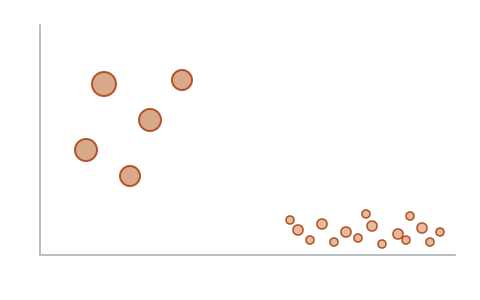
Common variants and rare variants. Schematic, not data. Each dot is a variant, placed by how common it is (across) and how large its effect is (up). The many dots on the right are common variants, each with a small effect. The few larger dots on the left are rare variants, each with a larger effect.
A 2026 preprint, not yet peer reviewed, models de novo coding mutations in 38,680 autism trios. It estimates that damaging de novo single-letter variants and frameshift indels (small insertions or deletions that shift how the code is read) explain about 3.4% of autism variance, that around 7% of cases carry a large-effect mutation, and that half the mutational variance comes from just 15 genes. Most of those large-effect changes are incompletely penetrant, so many people who carry one are not autistic.7 These figures are provisional until the work is peer reviewed.
Several big studies agree. They point to the same sets of genes.
A gene change that is in a child but in neither parent. It happened in the egg, the sperm, or very early on.
Common variants and rare variants. Schematic, not data. Each dot is a variant, placed by how common it is (across) and how large its effect is (up). The many dots on the right are common variants, each with a small effect. The few larger dots on the left are rare variants, each with a larger effect.
A 2026 preprint, not yet peer reviewed, models de novo coding mutations in 38,680 autism trios. It estimates that damaging de novo single-letter variants and frameshift indels (small insertions or deletions that shift how the code is read) explain about 3.4% of autism variance, that around 7% of cases carry a large-effect mutation, and that half the mutational variance comes from just 15 genes. Most of those large-effect changes are incompletely penetrant, so many people who carry one are not autistic.7 These figures are provisional until the work is peer reviewed.
The gene lists, and how they are built Emerging
Researchers keep curated lists of genes implicated in autism, scored by how strong the evidence is.8 A large exome study of 35,584 people identified 102 genes.5 A larger analysis of 63,237 people used a stricter threshold and named 72.3 The count grows as studies get bigger; a 2026 preprint reports 253, and a broader meta-analysis in the same preprint, adding developmental-disorder cohorts, brought the count to nearly 500.9 New sequencing methods find more still. Long-read sequencing, which reads longer stretches of DNA, detected about a third more gene-disrupting structural variants and more tandem repeats than standard short-read methods, and in one study of 267 people rare structural variants, tandem repeats and damaging single-letter variants together accounted for about 7% of the heritability of autism, with a wide range (2.7 to 17%).10
Scientists keep lists of genes involved in autism. They score each gene by how strong the evidence is.8 One big study found 102 genes.5 A bigger study used a stricter rule and found 72.3 The number grows as studies get bigger. A 2026 preprint found 253. A bigger analysis in the same preprint found nearly 500.9 Newer machines find more. Long-read sequencing reads longer pieces of DNA. It found more big changes than older machines did.10
The existence of the lists and the method for building them are settled. The lists are not: the count changes with the statistical threshold and the sample, and the newest figures come from preprints.
The part of the genome that codes for proteins, about 1 to 2% of the whole.
The idea of the lists is settled. The lists themselves keep changing. The newest numbers come from preprints.
The part of DNA that holds the plans for proteins. It is a small part of the whole.
Syndromic autism and single-gene conditions Established
A clinical genetic test does not diagnose autism. Autism is diagnosed from behavior, and a test looks for an underlying genetic condition that co-occurs with it.11,12 A small share of autistic people have such a condition.
Fragile X syndrome is one of the best-known single-gene causes. Fragile X testing was abnormal in about 0.5% of 861 autistic people in one clinical series,13 and autism is common in fragile X syndrome: estimates for males run up to 60%, and a meta-analysis of females gave a weighted average of 14% (13 to 18%).14 Other established causes include tuberous sclerosis complex, where about 30% of children are autistic,15 PTEN mutations,16 and recurrent copy-number variants at particular places in the genome, such as 16p11.2, 15q13.2q13.3, 7q11.23 and 22q11.2.13,17
Each of these raises the chance of autism. Not everyone with the condition is autistic.
A gene test does not diagnose autism. Doctors diagnose autism by watching how a person behaves. A gene test looks for a health condition that goes along with autism.11,12 A small number of autistic people have one.
Fragile X syndrome is one of the best-known single-gene causes. In one group of 861 autistic people, the fragile X test was unusual in about 0.5%.13 Autism is common in fragile X syndrome. For boys, up to 60% are autistic. For girls, about 14% are.14 Other known causes include tuberous sclerosis complex, where about 30% of children are autistic.15 Changes in the PTEN gene and missing or extra pieces of DNA are also causes.16,13,17
Each one raises the chance of autism. None makes it certain.
Fragile X syndrome, tuberous sclerosis complex and several recurrent copy-number variants are well-established genetic conditions that can include autism.
A stretch of DNA that is missing or duplicated, so a person has too few or too many copies of the genes in it.
These conditions are well known. Autism is often part of them.
A piece of DNA that is missing or doubled. The person has too few or too many copies of the genes in it.
The ancestry gap Established
Most autism genomic studies have been done in people of European ancestry, and this limits what the results can say about everyone else.18,19 When researchers studied autistic people of African ancestry, common-variant effect sizes looked similar, but polygenic scores built from European data transferred poorly to them, and they were less likely to carry rare variants in the genes identified in European cohorts.20 Admixture mapping in three cohorts found risk loci specific to particular ancestries,19 and a whole-genome study of Chinese families found rare variants in 19.2% of affected people.21
Most gene studies of autism have looked at people of European ancestry. So the results may not fit everyone else.18,19 Scientists studied autistic people of African ancestry. The common variants worked in a similar way. But gene scores built from European data did not fit them well. They were also less likely to have rare changes in the genes found in European studies.20 One study found risk spots tied to a person's ancestry.19 A study of Chinese families found rare changes in 19.2% of autistic people.21
That the genomic samples are mostly of European ancestry is a documented fact about the research, stated across reviews. The findings from other ancestries come from single studies and a preprint.
That most studies use people of European ancestry is a fact about the research. The findings in other groups come from single studies.
Polygenic scores Established
A polygenic score adds up the many common variants a person carries into one number. For autism it is a research tool. A systematic review and meta-analysis of 72 studies found the autism polygenic score consistently associated with an autism diagnosis, but the effect was small (a correlation of about 0.16) and inconsistent across other traits, so the authors concluded that it has no clinical utility and should be used only for research.22 European-derived scores transfer poorly to people of African ancestry, a 2025 preprint reports.20 No autism polygenic score is in routine clinical use as of October 2026.
A polygenic score adds up the small effects of many common variants into one number. For autism it is a research tool. A review of 72 studies found the score was tied to autism. But the link was small. The authors said it should be used only for research, not in clinics.22 Scores built from European data do not fit people of African ancestry well. A 2025 preprint reports this.20 No autism polygenic score is used in clinics as of October 2026.
A systematic review and meta-analysis of 72 studies supports both the association and the conclusion that the score is not clinically useful.
A single number that sums the small effects of many common variants, estimated from large studies.
A big review of 72 studies found the score is weak and not useful in clinics.
One number that adds up the tiny effects of many common variants.
What a clinical genetic test can find Established
Clinical genetic testing looks for a genetic cause that co-occurs with autism. Chromosomal microarray and fragile X testing have been the first-line tests, and exome or genome sequencing is increasingly used.11,12 In cohorts published between 2015 and 2023, a test found a pathogenic result in a minority of children: a combined microarray and exome yield of 15.8% among children who had both,23 pathogenic findings in 12.0% of the toddlers tested in one clinic,24 and pathogenic or likely pathogenic copy-number variants in 15.2% of one cohort.25 The most common result is that no single-gene cause is found. That does not mean autism is not genetic: the common variants that carry much of the contribution are not read by these tests.1,3
The yield is higher in children with physical anomalies or other unusual features, and it is not predicted by cognitive, language or motor test scores.23,24 A positive result often leads to further medical checks: in one clinic, 72.2% of pathogenic findings led to more testing or referrals.24
A variant of uncertain significance is a common result. The lab finds a change and cannot yet say whether it matters. In one cohort, 27.1% of people tested had one.25
A gene test looks for a health condition that goes along with autism. The first tests look for missing or extra pieces of DNA or check the fragile X gene. Some now read all the protein-coding DNA.11,12 In groups studied from 2015 to 2023, a test found a cause in a small number of children. When children had both kinds of test, 15.8% had a cause.23 In one clinic, 12.0% of the toddlers tested had a cause.24 In another group, 15.2% had a missing or extra piece of DNA.25 Most of the time, the test finds no single-gene cause. That does not mean autism is not genetic. The common variants that matter most are not read by these tests.1,3
The test finds a cause more often in children with unusual physical features. Test scores do not predict who will have one.23,24 When a cause is found, it often leads to more medical checks.24
Sometimes a test finds a change that no one can explain yet. This is called a variant of uncertain significance. In one group, 27.1% of people tested had one.25
Multiple independent clinical cohorts agree that a genetic test finds a cause in a minority of children. Each figure comes from one cohort, and the sample is named.
A change in DNA that a lab cannot yet classify as harmless or as a cause of a condition.
Many different clinics agree that a gene test finds a cause in a small number of children.
A DNA change that a lab cannot yet call harmless or harmful.
What a test cannot tell you, and what it costs Emerging
The tests in the previous section do not report the combined effect of the many common variants, which carry much of autism's genetic contribution, so a negative result is expected for most people who are tested. In one adult specialty clinic, a genetic cause was found in 28% of the 261 adults tested, but 73% of those had an intellectual disability, so that figure does not describe autistic adults in general.26
Cost is a barrier. A systematic review whose search ran to the end of 2015 found no economic evaluation of genetic testing for autism, and no study found as of October 2026 shows the tests to be cost-effective.27 The American College of Medical Genetics and Genomics recommends exome or genome sequencing as a first- or second-tier test for developmental delay and intellectual disability, and says it may be more cost-effective when ordered early.28 In practice, cost and insurance are the most common reason people decline testing,29 and testing is underused: 16.5% of one population sample reported any testing, and only 3% had both recommended tests.30
These tests do not report the combined effect of the many common variants. That is where much of autism's genetic contribution is. So most people who are tested get a negative result. In one clinic for adults, 28% of the 261 adults tested had a cause found. But 73% of those adults had an intellectual disability. So this number does not describe autistic adults in general.26
Cost can stop people from getting tested. A review looked at studies up to 2015. It found no study of whether the tests are worth the money. No study found as of October 2026 shows the tests are worth it.27 One doctors' group says exome or genome testing should be offered early for children with developmental delay.28 In real life, cost and insurance are the top reason people say no.29 Many people are not tested at all. In one group, 16.5% had any test, and only 3% had both recommended tests.30
The cost-effectiveness gap comes from a systematic review whose search ended in 2015, and the refusal and uptake figures come from single samples.
The cost finding comes from an older review. The other numbers come from single studies.
In the community Community
Autistic writers often describe autism as something that runs in families without a single gene behind it. Devon Price writes that "Genetics research shows that Autism runs in families, but it is not determined by any single gene."c1 Gina Rippon lists "hundreds of genes that, to date, have been implicated in autism", adding that "the current confirmed count is over a thousand".c2 Some writers treat the search for autism genes with caution: Jodie Hare describes how a 2021 plan to collect DNA from 10,000 autistic people "caused mass controversy in the autistic community", after some feared it "might be used to determine an 'autism gene' that could then be detected in pregnancy".c3
Autistic writers often say that autism runs in families, with no single gene behind it. Devon Price puts it this way: autism "runs in families, but it is not determined by any single gene".c1 Gina Rippon lists "hundreds of genes" involved in autism and says the count is "over a thousand".c2 Some writers are careful about gene research. Jodie Hare writes about a 2021 plan to collect DNA from 10,000 autistic people. She says it "caused mass controversy in the autistic community".c3
How autistic writers describe the genetics of autism, in their own words.
How autistic writers talk about autism genes, in their own words.
Sources
Research
- 1Grove J, Ripke S, Als TD, et al. Identification of common genetic risk variants for autism spectrum disorder. Nature Genetics, 2019. https://doi.org/10.1038/s41588-019-0344-8
- 2Zhang X, Grove J, Gu Y, et al. Polygenic and developmental profiles of autism differ by age at diagnosis. Nature, 2025. https://doi.org/10.1038/s41586-025-09542-6
- 3Fu JM, Satterstrom FK, Peng M, et al. Rare coding variation provides insight into the genetic architecture and phenotypic context of autism. Nature Genetics, 2022. https://doi.org/10.1038/s41588-022-01104-0
- 4Antaki D, Guevara J, Maihofer AX, et al. A phenotypic spectrum of autism is attributable to the combined effects of rare variants, polygenic risk and sex. Nature Genetics, 2022. https://doi.org/10.1038/s41588-022-01064-5
- 5Satterstrom FK, Kosmicki JA, Wang J, et al. Large-Scale Exome Sequencing Study Implicates Both Developmental and Functional Changes in the Neurobiology of Autism. Cell, 2020. https://doi.org/10.1016/j.cell.2019.12.036
- 6Lim ET, Uddin M, De Rubeis S, et al. Rates, distribution and implications of postzygotic mosaic mutations in autism spectrum disorder. Nature Neuroscience, 2017. https://doi.org/10.1038/nn.4598
- 7Nadig A, Fu J, Satterstrom FK, et al. Estimating the contribution of coding mutations to autism. medRxiv, 2026 (preprint, not peer reviewed). https://doi.org/10.64898/2026.08.25.26361328
- 8Abrahams BS, Arking DE, Campbell DB, et al. SFARI Gene 2.0: a community-driven knowledgebase for the autism spectrum disorders (ASDs). Molecular Autism, 2013. https://doi.org/10.1186/2040-2392-4-36
- 9Satterstrom FK, Auwerx C, Fu JM, et al. Rare variation illuminates the distinct and pleiotropic genetic architecture of autism across neuropsychiatric traits. medRxiv, 2026 (preprint, not peer reviewed). https://doi.org/10.64898/2026.08.24.26360398
- 10Mortazavi M, Guevara J, Diaz J, et al. Long-read genome sequencing improves detection and functional interpretation of structural and repeat variants in autism. Cell Genomics, 2026. https://doi.org/10.1016/j.xgen.2026.101186
- 11Vorstman JAS, Parr JR, Moreno-De-Luca D, et al. Autism genetics: opportunities and challenges for clinical translation. Nature Reviews Genetics, 2017. https://doi.org/10.1038/nrg.2017.4
- 12Hyman SL, Levy SE, Myers SM, Council on Children With Disabilities, Section on Developmental and Behavioral Pediatrics. Identification, Evaluation, and Management of Children With Autism Spectrum Disorder. Pediatrics, 2020. https://doi.org/10.1542/peds.2019-3447
- 13Shen Y, Dies KA, Holm IA, et al. Clinical genetic testing for patients with autism spectrum disorders. Pediatrics, 2010. https://doi.org/10.1542/peds.2009-1684
- 14Marlborough M, Welham A, Jones C, et al. Autism spectrum disorder in females with fragile X syndrome: a systematic review and meta-analysis of prevalence. Journal of Neurodevelopmental Disorders, 2021. https://doi.org/10.1186/s11689-021-09362-5
- 15Mitchell RA, Mitchell M, Williams K. The autism spectrum disorder phenotype in children with tuberous sclerosis complex: A systematic review and meta-analysis. Developmental Medicine & Child Neurology, 2022. https://doi.org/10.1111/dmcn.15307
- 16Genovese AC, Butler MG. PTEN Gene and Autism: Genetic Underpinnings and Neurodevelopmental Impacts. Genes, 2025. https://doi.org/10.3390/genes16091061
- 17Sanders SJ, Ercan-Sencicek AG, Hus V, et al. Multiple recurrent de novo CNVs, including duplications of the 7q11.23 Williams syndrome region, are strongly associated with autism. Neuron, 2011. https://doi.org/10.1016/j.neuron.2011.05.002
- 18Yang K, Geng Y, Zhou W, et al. Closing the Gap in Autism Genetics: Population-Specific Variants and the Imperative for Global Inclusion. Biological Psychiatry, 2026. https://doi.org/10.1016/j.biopsych.2026.03.999
- 19Mendes M, Xu CY, Engchuan W, et al. Characterizing features of the genetic architecture underlying autism from a multi-ancestry perspective. Molecular Psychiatry, 2026. https://doi.org/10.1038/s41380-026-03886-9
- 20Cirnigliaro M, Lowe JK, Flynn-Carroll AO, et al. Common and rare variant genetic contributions in African Americans with autism. medRxiv, 2025 (preprint, not peer reviewed). https://doi.org/10.1101/2025.11.18.25340532
- 21Tan S, Lyu Y, Sun X, et al. Genomic landscape of rare variants in a Chinese autism cohort and discovery of novel risk genes. Molecular Psychiatry, 2026. https://doi.org/10.1038/s41380-026-03754-6
- 22de Wit MM, Morgan MJ, Libedinsky I, et al. Systematic Review and Meta-Analysis: Phenotypic Correlates of the Autism Polygenic Score. JAACAP Open, 2025. https://doi.org/10.1016/j.jaacop.2025.04.001
- 23Tammimies K, Marshall CR, Walker S, et al. Molecular Diagnostic Yield of Chromosomal Microarray Analysis and Whole-Exome Sequencing in Children With Autism Spectrum Disorder. JAMA, 2015. https://doi.org/10.1001/jama.2015.10078
- 24Harris HK, Sideridis GD, Barbaresi WJ, Harstad E. Pathogenic Yield of Genetic Testing in Autism Spectrum Disorder. Pediatrics, 2020. https://doi.org/10.1542/peds.2019-3211
- 25Cucinotta F, Lintas C, Tomaiuolo P, et al. Diagnostic yield and clinical impact of chromosomal microarray analysis in autism spectrum disorder. Molecular Genetics & Genomic Medicine, 2023. https://doi.org/10.1002/mgg3.2182
- 26Mierau SB, Thom RP, Ravichandran CT, et al. Genetic Testing History in Adults With Autism Spectrum Disorder. Journal of Autism and Developmental Disorders, 2026. https://doi.org/10.1007/s10803-026-07265-9
- 27Ziegler A, Rudolph-Rothfeld W, Vonthein R. Genetic Testing for Autism Spectrum Disorder is Lacking Evidence of Cost-effectiveness. A Systematic Review. Methods of Information in Medicine, 2017. https://doi.org/10.3414/me16-01-0082
- 28Manickam K, McClain MR, Demmer LA, et al. Exome and genome sequencing for pediatric patients with congenital anomalies or intellectual disability: an evidence-based clinical guideline of the American College of Medical Genetics and Genomics (ACMG). Genetics in Medicine, 2021. https://doi.org/10.1038/s41436-021-01242-6
- 29Russell K, Arcebido K, Ibarra AM, et al. Reasons for refusal of genetic testing in the evaluation of autism spectrum disorder and intellectual developmental disorder with longitudinal follow-up on test completion. Genetics in Medicine Open, 2026. https://doi.org/10.1016/j.gimo.2026.104413
- 30Moreno-De-Luca D, Kavanaugh BC, Best CR, et al. Clinical Genetic Testing in Autism Spectrum Disorder in a Large Community-Based Population Sample. JAMA Psychiatry, 2020. https://doi.org/10.1001/jamapsychiatry.2020.0950
Community sources
- c1Price D. Unmasking for Life: The Autistic Person's Guide to Connecting, Loving, and Living Authentically. Harmony Books, 2025. Chapter "Family". Devon Price's site
- c2Rippon G. Off the Spectrum. Basic Books, 2025. Chapter 5.
- c3Hare J. Autism Is Not a Disease: The Politics of Neurodiversity. Verso Books, 2024. Chapter 2.